
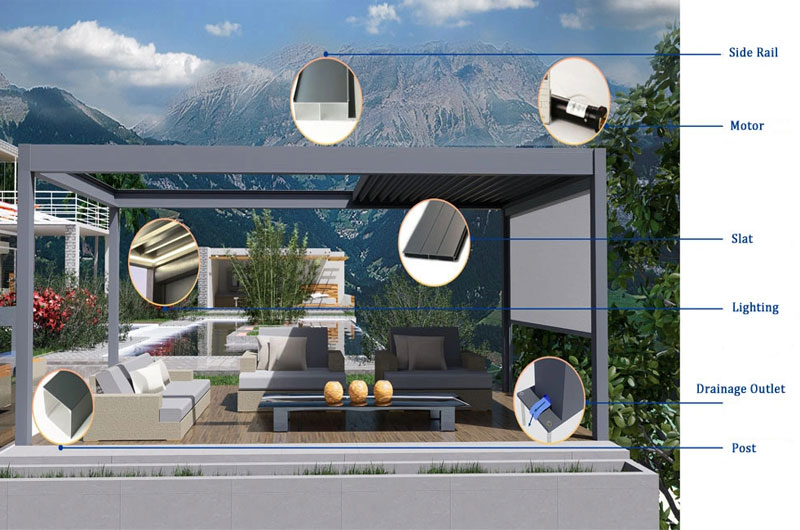
Understanding the main components of an aluminum louvered pergola is key to appreciating how they work, how they’re built, and how to care for them.
In this article, we’ll break down the essential parts of an aluminum louvered pergola — from structural supports to moving parts — and explain how each contributes to performance, durability, and user experience.
1. Posts (Vertical Support Columns)
The posts or support columns are the foundational vertical elements of the pergola. They anchor the structure to the ground and carry the load of the entire pergola system. Aluminum pergola posts are typically square or rectangular tubes made from extruded aluminum — a material chosen for its excellent strength-to-weight ratio and corrosion resistance.
Key Functions:
- Provide structural support and stability
- Transfer load to footings or base
- Define the vertical boundary of the pergola
Posts often come with decorative covers or caps to enhance aesthetic appeal and may house internal wiring for lighting or automated systems.
2. Beams (Horizontal Support Members)
Beams run horizontally across the top of the posts and act as the primary load-bearing components. In louvered pergolas, beams support the entire louver system and help distribute loads to the posts.
Key Functions:
- Support louvers and any additional features
- Connect posts across the pergola span
- Provide rigidity to the overall frame
Beams are usually bolted or welded to the posts and may include drainage channels to manage rainwater diverted from the louvers.
3. Louvers (Adjustable Slats)
At the heart of a louvered pergola are the louvers — the adjustable slats that form the roof. These louvers can be tilted to different angles to control sunlight, shade, and airflow. When fully closed, they form a weather-resistant roof; when open, they allow sunlight and ventilation.
Key Functions:
- Control shade, light, and airflow
- Provide shelter from rain when closed
- Enhance comfort in outdoor spaces
Louvers are typically motor-operated or manually adjustable. Motorized systems use a remote or app to tilt the louvers, while manual systems use a crank or handle. Aluminum louvers are powder-coated for durability and may feature drainage channels to direct water away from seating areas.
4. Drip Edges and Guttering System
To handle rainwater effectively, many aluminum louvered pergolas incorporate drip edges and an integrated guttering system.
Drip Edges
Drip edges are small lips along the edges of louvers that prevent water from dripping down the sides. They help guide water toward the built-in channels instead of letting it fall directly underneath the pergola.
Gutter System
The guttering system is often hidden within the header beams or posts. When the louvers are closed, rainwater is captured along the louver channels and directed into gutters that lead water down through internal post channels or exterior downspouts.
Key Functions:
- Manage rainwater efficiently
- Keep the pergola space dry
- Protect furniture and flooring beneath
This thoughtful water management enhances comfort and prevents pooling or damage.
5. Header/Top Rails
Headers or top rails are the horizontal framing components at the fascia of the pergola. They anchor the louvers at the front and back edges and connect the beams across the width.
Key Functions:
- Provide mounting points for motor and louvers
- Add structural integrity to pergola roof
- Help define the shape and profile of the pergola
Headers may include decorative trims and support internal lighting or rain sensors.
6. Motor and Drive Mechanism
Most modern aluminum louvered pergolas use a motorized drive system for adjusting the louvers. The motor assembly may be built into the pergola frame and connected to a drive shaft that tilts the louvers synchronously.
Components:
- Motor unit (electric)
- Drive shaft or linkage system
- Control panel, remote, or app integration
Key Functions:
- Enable effortless opening/closing of louvers
- Offer variable tilt positions for optimal comfort
- Integrate with smart home systems or weather sensors
High-quality motors are weatherproof and rated for outdoor performance.
7. Control System (Remote/App/Wired Controls)
To operate the louvered roof, pergolas come with a control system. Common options include:
- Handheld remote
- Wall-mounted switch
- Smartphone app
- Integration with home automation (e.g., Alexa, Google Home)
Advanced systems may also connect to weather sensors, which automatically close the louvers during rain or high winds.
Key Functions:
- Allow easy adjustments without manual effort
- Offer programmable settings for comfort
- Improve convenience and automation
8. Corner Brackets and Fasteners
Corner brackets and fasteners (bolts, screws, clips) are the unseen hardware that holds the pergola together. Although small, they’re critical for strength and durability.
Key Functions:
- Secure structural members
- Ensure precise alignment
- Provide resistance to wind and environmental stress
High-quality stainless steel or coated hardware prevents corrosion and contributes to the longevity of the pergola.
9. Optional Accessories
Aluminum louvered pergolas can be customized with optional accessories that enhance utility and comfort. Common add-ons include:
Lighting
Recessed LED strips or spotlights integrated into the beams or posts improve evening ambiance.
Ceiling Fans
Mounted fans help circulate air on hot days.
Shade Screens/Retractable Walls
Side screens add privacy and protect against low-angle sun or insects.
Heaters
Infrared or electric heaters extend usability into cooler seasons.
Key Functions of Accessories:
- Upgrade comfort and usability
- Allow customization for specific needs
- Improve year-round outdoor enjoyment
10. Foundation/Base Plates
The pergola posts are anchored to the ground using foundation plates or anchor bolts. These may be mounted to a concrete slab, deck surface, or footings below grade.
Key Functions:
- Provide structural anchoring
- Prevent lateral movement
- Ensure safety and compliance with building codes
A secure foundation is essential for long-term performance, especially in areas prone to wind or seismic activity.