
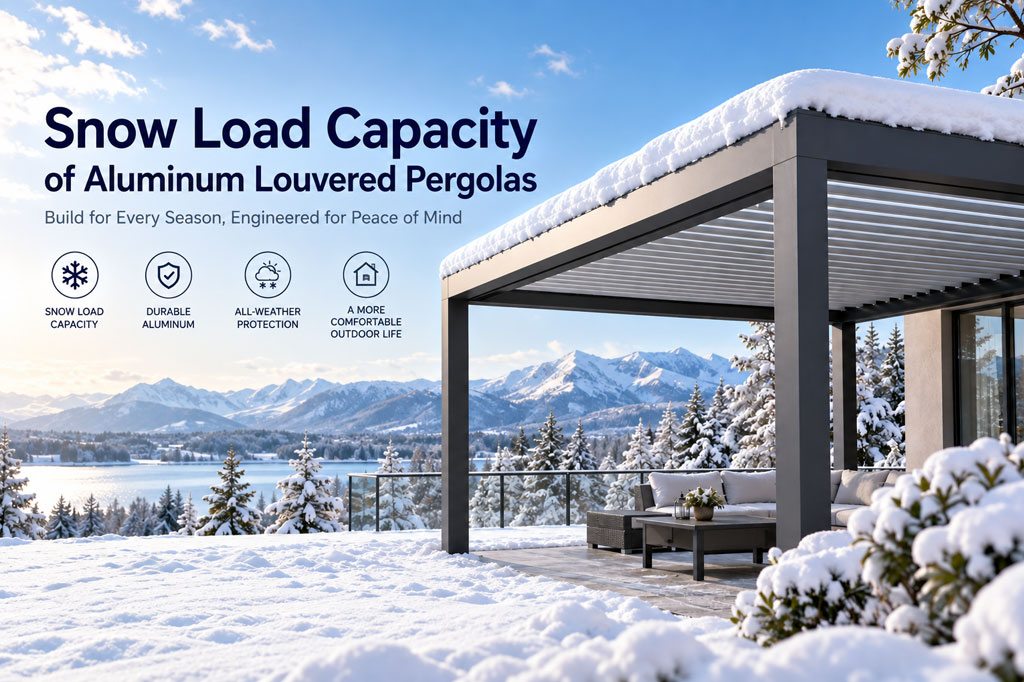
In regions with cold winters, sunlight and rain protection are only part of the purchasing decision. The aluminum louvered pergola must also be suitable for the local snow conditions.
Snow-load capacity describes how much downward snow load an aluminum louvered pergola roof can support under defined conditions. It is commonly expressed in kilograms per square meter, kilonewtons per square meter, or pounds per square foot.
A higher number may suggest a stronger system, but the rating alone does not tell the complete story. Pergola dimensions, louver position, snow distribution, foundation design, adjacent buildings, installation quality, and local regulations all affect real-world performance.
What Does Snow-Load Capacity Mean?
Snow-load capacity is the specified load that a roof structure is designed or tested to resist over a given area.
It may be shown as:
- kg/m² — kilograms per square meter
- kN/m² — kilonewtons per square meter
- kPa — kilopascals
- psf — pounds per square foot
In product literature, kg/m² is often used as convenient shorthand for the weight applied over one square meter.
Approximate conversions include:
| kg/m² | kN/m² or kPa | psf |
|---|---|---|
| 50 | 0.49 | 10.2 |
| 100 | 0.98 | 20.5 |
| 120 | 1.18 | 24.6 |
| 150 | 1.47 | 30.7 |
| 200 | 1.96 | 41.0 |
If a pergola specification lists a snow-load capacity of 120 kg/m², this is approximately equal to 1.18 kN/m² or 24.6 psf.
However, this does not mean the product is suitable for every location with a design snow load below that figure. The stated capacity must correspond to the actual pergola size, configuration, support conditions, and required building standard.
What Determines a Pergola’s Snow-Load Capacity?
Snow-load performance is created by the complete structure rather than the aluminum material alone.
Important factors include the following.
1. Aluminum Profile Dimensions
The depth, width, wall thickness, alloy, and temper of the structural profiles affect their ability to resist bending.
This applies to:
- Louvers
- Perimeter beams
- Intermediate beams
- Posts
- Internal reinforcement
- Tracks and support rails
A large-looking profile is not necessarily stronger if it has inadequate wall thickness or internal reinforcement.
2. Louver Span
The distance each louver spans between supports is critical. Longer louvers generally experience more bending under the same load.
A snow-load rating established for a small module should not automatically be applied to a larger aluminum louvered pergola. Large systems may require wider louvers, deeper beams, intermediate supports, or multiple modules.
3. Pergola Dimensions
Snow-load capacity may change with:
- Overall length and width
- Number of roof bays
- Post spacing
- Post height
- Freestanding or wall-mounted configuration
- Cantilevered sections
- Custom openings or cutouts
Ask for a rating or calculation that matches the dimensions of the proposed project.
4. Louver Position
Motorized and manual pergolas can place the louvers at different angles. The structural and snow-accumulation conditions may change when the roof is open, partially open, or fully closed.
Never assume that opening the louvers will safely release accumulated snow. Wet snow and ice may bridge between blades, block movement, or fall unpredictably.
The manufacturer should specify the required louver position for snowfall, severe weather, and periods when the pergola is unattended.
5. Connections and Mechanical Components
Snow loads must pass through louver pivots, brackets, drive linkages, beams, posts, base plates, anchors, and foundations.
A strong louver is not sufficient if another connection in the load path is weaker.
Motorized components must also be protected from overload. The motor is designed to move the louvers—not to break or lift accumulated snow and ice.
6. Foundations and Anchors
The pergola’s stated capacity normally assumes that it is installed on a suitable foundation using the specified anchors.
Depending on the project, this may include:
- Reinforced concrete slabs
- Dedicated concrete footings
- Engineered rooftop supports
- Reinforced deck framing
- Structural wall connections
An incorrectly anchored pergola may not achieve its intended performance even if the aluminum frame itself is sufficiently strong.
How to Compare Snow-Load Claims
When comparing pergola suppliers, ask what the published rating actually represents.
Important questions include:
- Is the figure a working load, design load, test load, or failure load?
- Is it based on testing or structural calculations?
- Does it include a safety factor?
- Is the load uniformly distributed?
- What pergola dimensions were used?
- What was the unsupported louver span?
- Was the roof open, partially open, or closed?
- Does the rating apply to a freestanding or wall-mounted system?
- Which anchors and foundations were assumed?
- Does it include snow drifting or unbalanced loading?
- What deflection limit was applied?
- Which standard or test method was used?
- Does the rating apply to the exact quoted configuration?
- Are structural calculations available for local approval?
A supplier should not apply the rating of its smallest or strongest test configuration to every custom pergola size.
How Pergola Accessories Affect Winter Performance
Accessories can change the structural behavior of the complete pergola.
These may include:
- Zip blinds
- Glass sliding doors
- Privacy panels
- Electric lift windows
- Heaters
- Lighting
- Solar panels
- Ceiling fans
- Decorative ceiling systems
Enclosed sides can alter wind patterns and cause snow to accumulate differently around the roof. Hanging accessories add permanent weight that should be included in the structural design.
Do not add heavy equipment to the roof or beams after installation without approval.
Can a Pergola Be Reinforced for Higher Snow Loads?
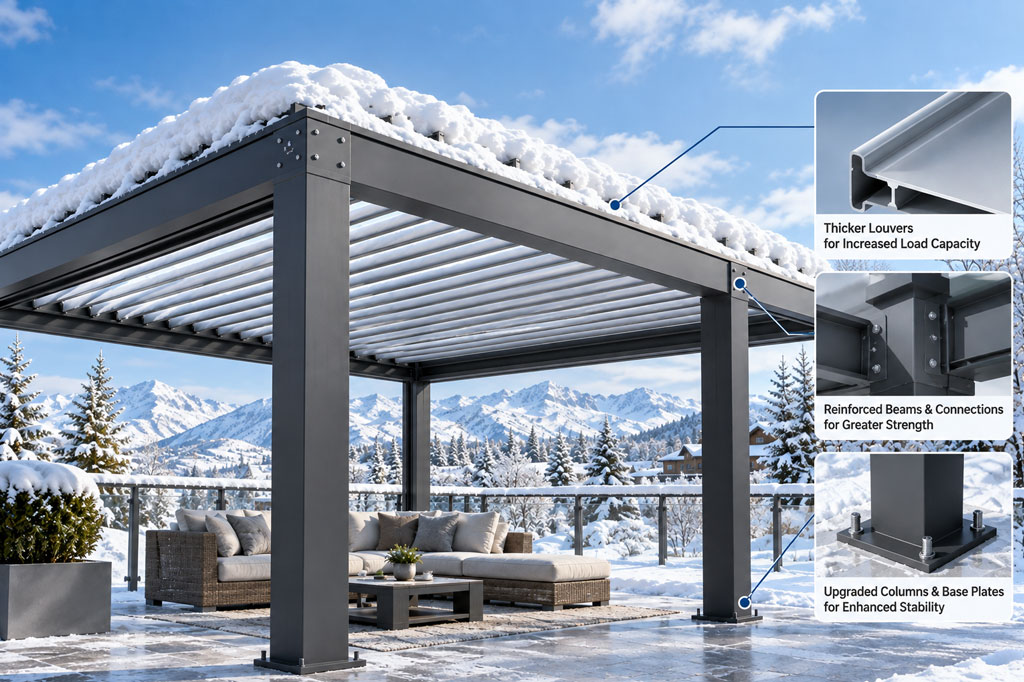
Yes, depending on the product system and project requirements.
Possible engineering changes include:
- Shorter louver spans
- Larger or thicker aluminum profiles
- Reinforced beams
- Additional intermediate beams
- Extra posts
- Smaller roof modules
- Stronger brackets and connectors
- Enhanced wall connections
- Larger base plates
- Upgraded anchors
- Larger concrete footings
Reinforcement should be incorporated during design rather than added after manufacturing whenever possible.
Final Thoughts
Snow-load capacity is an essential consideration when choosing an aluminum louvered pergola for a cold climate. However, one number on a product page is not enough to confirm suitability.
Buyers should compare the required local roof snow load with a project-specific pergola rating that accounts for dimensions, louver span, roof position, drifting, connections, installation type, anchors, and foundations.
When requesting a quotation, provide the exact installation address, site elevation, pergola dimensions, photographs, building drawings, and information about nearby roofs or walls. This allows the manufacturer and local structural professional to evaluate the actual conditions and propose an appropriate configuration.