
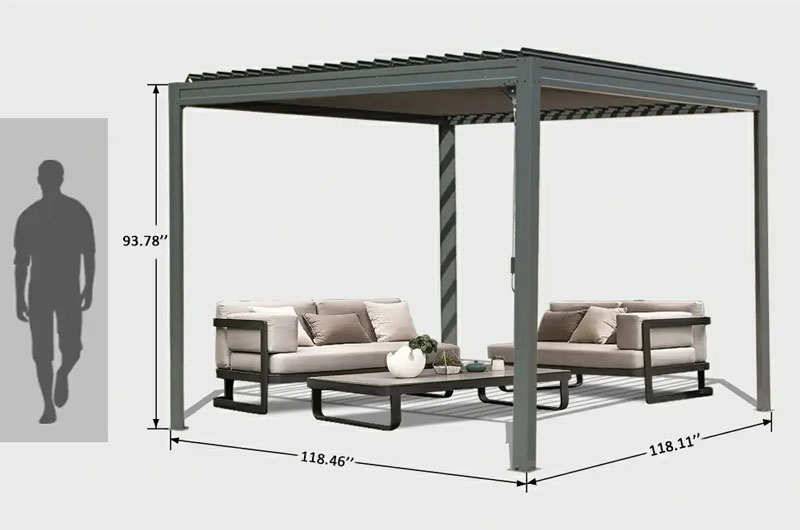
When planning an outdoor space, the size of your aluminum louvered pergola plays a crucial role in both aesthetics and functionality.
Understanding the dimensions and proportions of your space, as well as your lifestyle needs, is the first step toward selecting a pergola.
This guide walks you through the key factors to consider when sizing your aluminum louvered pergola — from assessing your space and needs to thinking about future use, structural requirements, and aesthetic balance.
1. Start with Purpose: Define How You’ll Use It
Before measuring anything, ask yourself:
- What will the space be used for?
- Dining area?
- Outdoor kitchen?
- Lounge/entertainment zone?
- Poolside shade?
- Workspace or yoga area?
Your intended use determines the minimum size needed. For example:
- A dining area for 6–8 people typically needs at least 12′ × 12′ to allow table, chairs, and circulation.
- A lounge area with sofas and a coffee table might require 10′ × 14′ or larger for comfort.
- An outdoor kitchen often demands extra depth (e.g., 12′ × 16′) to accommodate counters, appliances, and prep space.
Rule of Thumb: Think in terms of functional zones — how much space you need around furniture and for movement, rather than just the pergola footprint itself.
2. Measure Your Outdoor Space Carefully
Accurate measurements form the foundation of the right pergola size. Walk through these steps:
A. Identify Space Boundaries
Use a tape measure to capture:
- Width (left to right)
- Depth (front to back)
- Clearance from house walls, fences, trees, or other features
Draw a simple sketch with dimensions labeled.
B. Note Structural Obstacles
Record any:
- Roof overhangs
- Windows and doors that might conflict with pergola placement
- Utility lines
- Trees, planters, or drainage paths
These will affect both size and position.
C. Check Overhead Clearance
While aluminum pergolas don’t need tall clearance like sail shades, if you plan to adjust louvers to full open, ensure enough vertical space to avoid hitting eaves or low structures.
3. Consider Furniture and Traffic Flow
A pergola should accommodate your outdoor activities, not just sit in a corner.
A. Map Out Furniture Footprint
Place tape or chalk on your patio to mark where key pieces will go. For example:
- Dining table with chairs: account for chair movement
- Sofa and coffee table: leave space to walk around
- Bar or grill island: clearance for cooking and service
B. Allow Traffic Zones
Leave at least 3 feet of clearance around seating and pathways so people can move easily without brushes or collisions.
4. Plan for Shade Adjustability and Sun Angles
One of the best features of a louvered pergola is the adjustable blades. To optimize shade:
A. Note Sun Path
Identify the direction of:
- Morning sun
- Midday sun
- Afternoon sun
You can use a compass or a phone app. The pergola should be oriented to provide maximum shade when needed most often, with longer sides facing east/west.
B. Size for Shade Coverage
If late afternoon sun is an issue, consider extending the pergola deeper (front to back) so adjustable louvers can cast shade further across your space during peak heat hours.
5. Align with Architectural Proportions
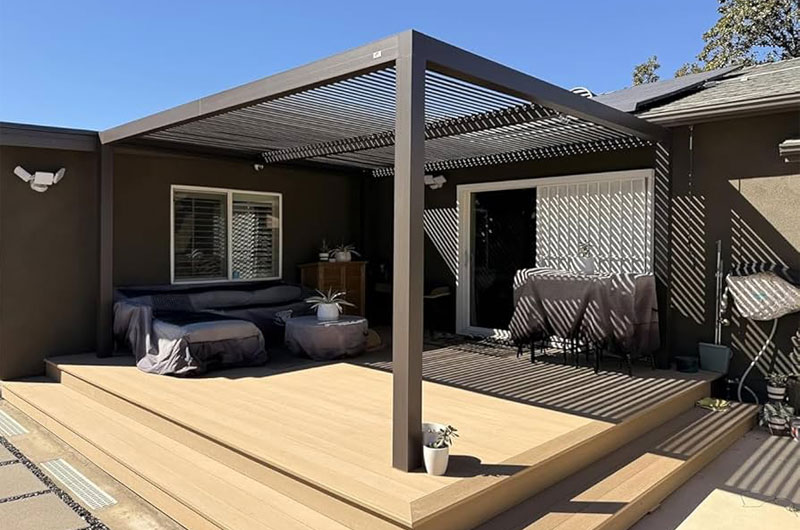
Your pergola should feel connected to the architecture, not like an afterthought.
A. Match Building Scale
- A tiny pergola on a large patio looks lost.
- A huge pergola on a small porch can overwhelm.
Visual balance tips:
- Pergola width should be proportional to house features like doors and windows.
- For wall-attached pergolas, the length often aligns with the run of sliding doors or outdoor living walls.
B. Consider Height
Standard pergola heights are generally 8’–12′. Taller pergolas can feel grand, but excessively tall ones may block sightlines or feel disconnected from lower rooflines.
6. Think About Future Use and Expansion
What you want today may change tomorrow.
A. Entertaining and Growth
If you plan to:
- Host larger gatherings
- Add outdoor heaters
- Attach curtains, lighting, or fans
Then sizing up a little can be worth the investment.
B. Flexible Add-Ons
Modular pergolas allow:
- Side screens
- Roll-down shades
- Retractable roofs
If you anticipate adding these, leave a buffer around the structure for hardware and movement.
7. Structural Considerations and Building Codes
Permits and structural requirements vary based on size in many jurisdictions.
A. Permit Thresholds
Often:
- Pergolas over a certain size (e.g., 120 sq ft) require a permit.
- Local codes may mandate setbacks from property lines.
Check with your city’s planning department before finalizing.
B. Wind and Snow Loads
Even in mild climates, aluminum pergolas must be designed for local weather conditions. Larger spans may require:
- Heavier posts
- Deeper footings
- Cross-bracing
Your pergola supplier or contractor should engineer the frame accordingly.
8. Budget Impact of Size
Size directly affects cost:
- Larger aluminum pergolas demand increased materials and more labor to construct.
- Complex shapes (L-shapes, extensions) can cost more.
- Structural upgrades add to expenses.
A rule of thumb: Start with the necessary functional size, then scale up only for practical or aesthetic reasons.
9. Custom Shapes and Extensions
Not all outdoor spaces are rectangles, and your pergola doesn’t have to be either.
A. L-Shaped Pergolas
For wraparound patios or connecting different zones.
B. Multi-Section Pergolas
Useful for:
- Dining + lounge areas
- Poolside + outdoor kitchen
These can be tailored in size but require careful planning to maintain consistent louver operation and structural integrity.
10. Final Checklist Before Ordering
Before you purchase or order a quote, review this checklist:
- Clear dimensions labeled on a site sketch
- Furniture layout and traffic paths mapped
- Sun path and orientation considered
- Local codes and permits checked
- Desired features (screens, lighting, fans) accounted for
- Height, proportion, and aesthetics assessed
- Budget constraints evaluated