
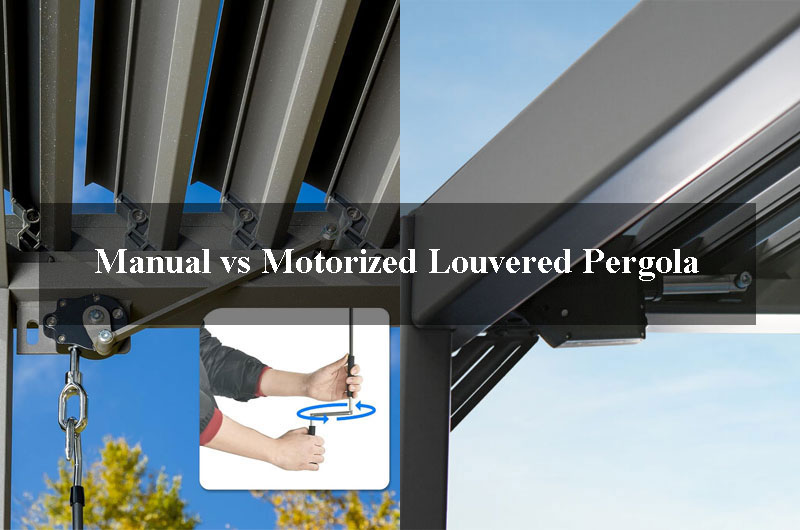
Among modern outdoor living options, louvered pergolas stand out for their versatility, offering adjustable slats that control sunlight, airflow, and even rain protection.
But within this category lies an important decision: manual or motorized operation?
What Is a Louvered Pergola?
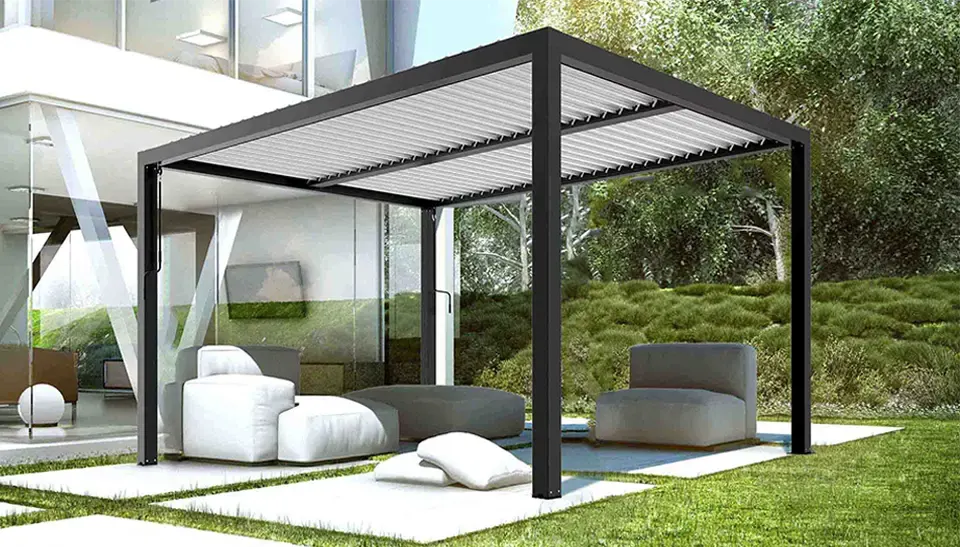
A louvered pergola features horizontal slats (louvers) that can rotate to open or close. When open, they allow sunlight and breeze; when closed, they offer shade and rain protection.
Unlike fixed pergolas, louvered designs adapt to changing weather and comfort needs.
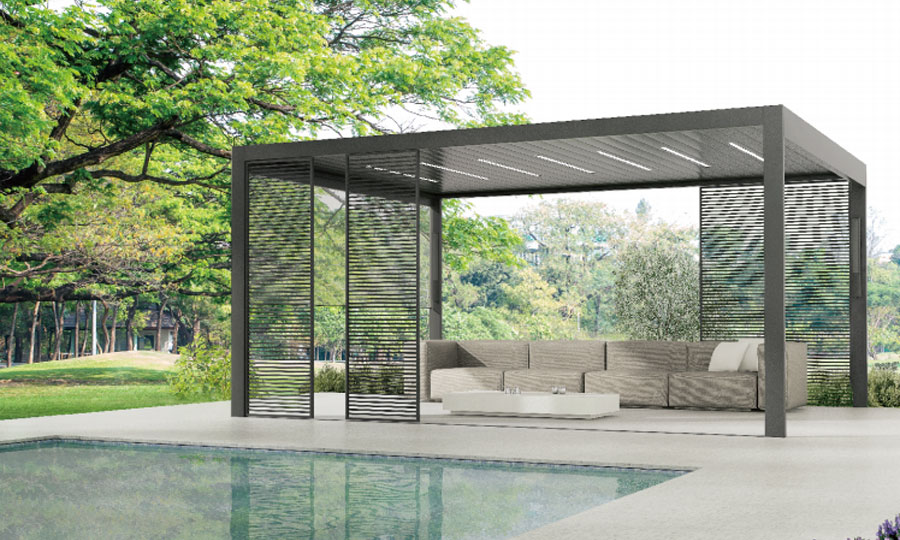
These structures can be freestanding, attached to a building, or integrated into a patio or deck. They are popular in residential backyards, outdoor dining areas, poolside retreats, and commercial patios.
Manual Louvered Pergolas
In a manual system, the louvers are adjusted by hand, either with a crank handle, lever, or simple push/pull mechanism. There are no electric motors or automated controls.
Pros of Manual Pergolas
- Cost-Effective
Manual louvered pergolas are generally more affordable to buy and install since they don’t rely on motors or electrical systems, making them ideal for budget-conscious homeowners. - Simpler Installation
With no wiring or automation involved, installation is faster and more straightforward, and experienced DIYers may even handle it themselves. - Reliable and Low-Maintenance
Fewer moving parts and no electrical systems mean fewer things that can fail. Simple mechanical systems are easier to repair and maintain. - No Dependence on Power
Manual pergolas function regardless of electricity availability, handy in off-grid settings or areas with frequent power outages. - Aesthetic Simplicity
For some homeowners, manual systems are visually cleaner with fewer visible components.
Cons of Manual Pergolas
- Physical Effort Required
Adjusting the louvers by hand takes physical effort, especially for large pergolas or frequent adjustments. This may be inconvenient in daily use. - Less Precise Control
While you can position louvers to many angles, manual systems don’t offer the precision of automated stops and preset positions. - Limited Remote Operation
You must be physically present to adjust the pergola. If you’re inside your home and the weather changes suddenly, you’ll need to walk outside. - Wear Over Time
Mechanical levers and cranks can wear down or loosen over years of use.
Motorized Louvered Pergolas
Pros of Motorized Pergolas
- Convenience and Comfort
At the touch of a button or hands-free with automation, you can open, close, or partially tilt the louvers. It’s effortless and perfect for daily comfort management. - Smart Controls
Integration with smart home ecosystems lets you schedule adjustments or respond to weather automatically. Rain sensors can close louvers during a storm; sun sensors can optimize shade through the day. - Precision and Flexibility
Motorized systems offer accurate positioning and smooth transitions. You can fine-tune louvers to your exact comfort level. - Enhanced Property Value
Automated outdoor systems are often seen as high-end upgrades that increase appeal and resale value. - Ideal for Larger Spaces
With manual systems, adjusting large pergolas can be strenuous. Motors handle heavier loads effortlessly.
Cons of Motorized Pergolas
- Higher Cost
Motorized louvered pergolas are more expensive upfront due to motors, sensors, wiring, and controls. Installation costs are also higher if electrical work is needed. - Electricity Dependence
These systems require power. During outages, you may lose control unless there’s a backup system or manual override. - More Components to Maintain
Motors and control electronics can fail and may require professional maintenance. Repairs can be more expensive than in manual systems. - Installation Complexity
Proper installation requires electrical expertise. You may need permits or professional labor, especially for integrated smart home setups.
Side-by-Side Comparison
| Feature | Manual Louvered Pergola | Motorized Louvered Pergola |
|---|---|---|
| Upfront Cost | Lower | Higher |
| Installation Complexity | Simple | Complex |
| Ease of Use | Moderate (manual effort) | Excellent (remote/auto) |
| Maintenance | Low | Moderate to High |
| Precision Control | Basic | High |
| Automation Capability | No | Yes |
| Reliance on Electricity | No | Yes |
| Best for Large Pergolas | Less ideal | Ideal |
| Resale Value Impact | Neutral | Positive |
Final Thoughts
Both manual and motorized louvered pergolas bring adaptable, stylish shade to your outdoor living space. Your choice depends on budget, lifestyle, size of the pergola, and desired convenience.
- Choose manual if you value simplicity, low-cost installation, and a system that’s easy to maintain.
- Opt for motorized if you want effortless, high-tech control with automation that enhances comfort and functionality.