
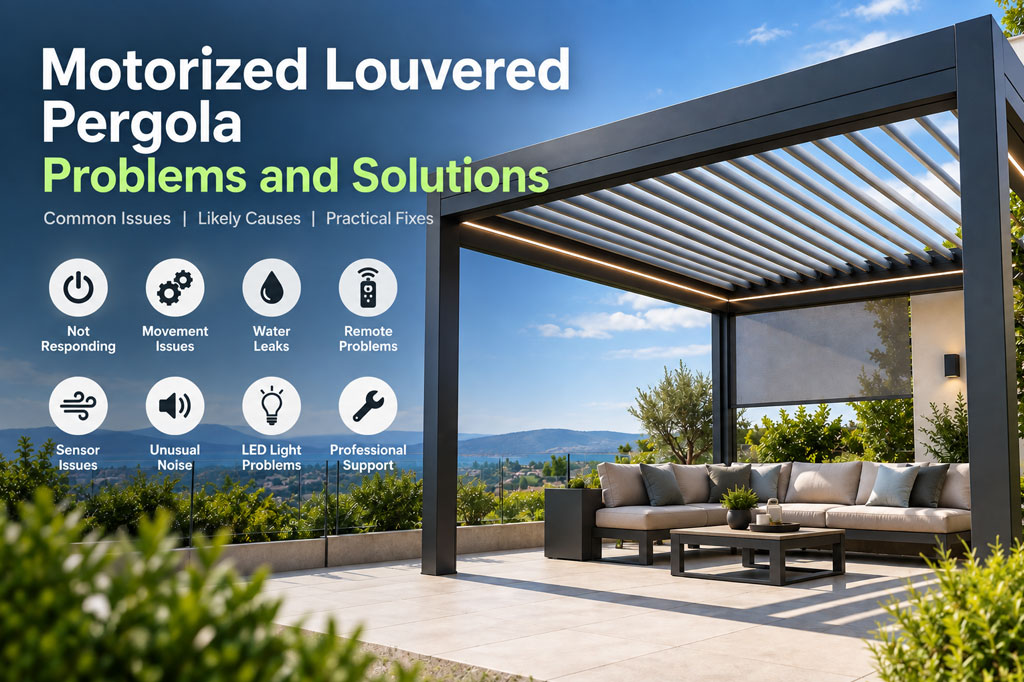
Like any outdoor mechanical and electrical system, a motorized pergola may occasionally develop operational problems.
Many minor issues can be traced to batteries, debris, blocked drainage, or incorrect settings. Others—especially those involving electrical components, damaged linkages, or structural movement—require professional service.
This guide explains the most common motorized louvered pergola problems, their likely causes, and the safest ways to address them.
Quick Troubleshooting Guide
| Problem | Possible Causes | First Safe Check |
|---|---|---|
| Pergola does not respond | Power loss, remote battery, pairing issue | Check the external power supply and remote battery |
| Motor runs but louvers do not move | Obstruction, damaged linkage, misalignment | Stop operation and inspect for visible debris |
| Louvers stop halfway | Overload protection, obstruction, incorrect limit setting | Allow the system to rest and check for blockage |
| Louvers move unevenly | Linkage problem, loose component, frame movement | Stop using the roof and contact the installer |
| Louvers do not close fully | Debris, damaged seal, calibration problem | Clean accessible contact areas and inspect seals |
| Water drips through the roof | Blocked gutter, damaged gasket, poor alignment | Clear gutters and drainage outlets |
| Remote works only at close range | Weak battery, interference, receiver problem | Replace the battery and test from another position |
| Weather sensor activates incorrectly | Dirt, battery, placement or pairing issue | Clean and test the sensor according to its manual |
| Motor makes unusual noise | Debris, friction, loose hardware or worn parts | Stop operation and identify the source |
| LED lights flicker | Driver, power-supply or moisture problem | Turn off the affected circuit and call a technician |
1. The Pergola Does Not Respond
One of the most common complaints is that nothing happens when the user presses the remote control or wall switch.
Possible causes
- A discharged remote-control battery
- Incorrect battery installation
- Loss of power to the control unit
- A tripped breaker or safety device
- A switched-off isolator
- Lost pairing between the remote and receiver
- Signal interference
- Moisture inside an electrical component
- A motor or controller fault
Solutions
Start with the simplest checks:
- Replace the remote battery with the correct type.
- Confirm that the battery polarity is correct.
- Try another paired remote or wall control, if available.
- Check whether the external isolator is switched on.
- Inspect the relevant breaker without opening electrical equipment.
- Confirm whether other pergola accessories have power.
If the lighting works but the louvers do not, the roof motor may be on a separate output or control channel.
Re-pairing procedures vary between control systems. Follow the product manual exactly because an incorrect sequence may delete existing remotes, sensor settings, or travel limits.
If there are signs of water inside a receiver, transformer, or control box, disconnect the power and arrange professional inspection before operating the system again.
2. The Louvers Stop Halfway
A roof that begins moving but stops before reaching its intended position may be responding to an obstruction or protection feature.
Possible causes
- Leaves, branches, stones, or insects blocking movement
- Ice between adjacent louvers
- A bent or misaligned blade
- Motor overload protection
- Motor temperature protection
- Incorrect travel-limit settings
- Excessive friction in the linkage
- Low or unstable supply voltage
Solutions
Stop repeatedly pressing the control button. Continuous attempts can place additional stress on the motor and mechanical components.
After isolating the power, inspect the roof from a safe position. Remove only loose, easily accessible debris. Do not reach into pivot points or dismantle the linkage.
If the motor has operated repeatedly in a short period, it may have activated its thermal or duty-cycle protection. Allow it to rest for the period specified in the manual, then test it once.
Repeated stopping at the same position usually indicates an obstruction, alignment problem, or incorrect limit setting. A technician should inspect the motor load and louver mechanism.
3. The Motor Runs, but the Louvers Do Not Move
If the motor can be heard but the roof remains stationary, power is reaching at least part of the system. The problem may be within the mechanical connection.
Possible causes
- A disconnected drive arm
- A damaged gearbox or coupling
- A loose shaft connection
- A broken linkage component
- A severely jammed louver
- Internal motor damage
Solutions
Stop the motor immediately. Allowing it to continue running without moving the louvers may worsen the damage.
Do not attempt to push the blades manually. Photograph the position of the louvers and note whether the sound comes from the motor, a beam, or one particular blade.
This problem generally requires an installer or authorized technician to open the mechanism and check the drive system.
4. The Louvers Move Unevenly or Out of Sequence
All louvers within one operating zone should normally move together. If one blade remains at a different angle, or one side of the roof moves ahead of the other, stop operating the system.
Possible causes
- A louver has disconnected from the drive linkage
- A pivot or bracket is loose
- The frame is no longer square
- A blade has been bent by impact
- A multi-zone control system has lost synchronization
- Installation fasteners have moved or loosened
Solutions
Visually compare the blade angles without standing beneath the moving roof. Check whether the problem affects one blade, one roof zone, or the entire system.
Do not continue cycling the roof in an attempt to make it realign itself. A disconnected blade can collide with adjacent louvers and cause further damage.
The installer should inspect the linkage, pivots, frame alignment, and controller calibration before the pergola returns to normal use.
5. The Louvers Do Not Close Completely
A small gap between louvers can reduce shade performance and allow more rainwater to enter.
Possible causes
- Debris on the louver edges
- Dirt around seals or contact surfaces
- Incorrect motor-limit settings
- Damaged or displaced rubber gaskets
- A bent blade
- Linkage misalignment
- Structural movement
Solutions
Isolate the power and clean accessible louver edges using a soft brush, water, and a mild cleaner. Inspect visible gaskets for tears, brittleness, or displacement. Use only manufacturer-approved replacement seals.
If the louvers still stop before reaching the correct closed position, the travel limits or linkage may need adjustment. This work should be performed according to the specific motor and controller instructions.
6. Water Leaks Through the Closed Roof
A motorized louvered roof normally manages rainwater by directing it from the blades into perimeter gutters and down through the posts. Dripping does not always mean that the roof mechanism has failed.
Possible causes
- Leaves or dirt blocking the gutters
- Blocked outlets inside the posts
- Damaged or displaced seals
- Louvers not reaching the fully closed position
- Frame or blade misalignment
- Incorrect drainage connections
- Rainfall exceeding the system’s design capacity
- Wind-driven rain entering from the sides
- Condensation underneath the blades
Solutions
Clean the gutters and confirm that every drainage outlet is open. Check where the water exits the posts and ensure that landscaping, paving, or connecting pipes are not restricting the flow.
Run a controlled water test using a garden hose at low volume. Observe whether water drains consistently from all outlets. Avoid directing a high-pressure stream upward between the louvers, as this does not represent normal rainfall.
A drip at one repeated location may indicate a damaged gasket or misaligned blade. Overflow along a beam is more likely to suggest a blocked or undersized drainage path.
A louvered pergola provides weather protection but is not necessarily equivalent to a fully sealed indoor roof. Wind direction, rainfall intensity, installation details, and side enclosures all affect performance.
7. The Remote Has Limited Range or Works Intermittently
A remote that only works from a short distance may have a battery or signal problem rather than a motor failure.
Possible causes
- Weak remote battery
- Radio interference
- Metal or concrete obstructing the signal
- Incorrect receiver position
- Moisture inside the receiver
- Damaged antenna
- Pairing or channel-selection problem
Solutions
Replace the battery and test the remote from several positions. Make sure the correct pergola zone or channel is selected.
Move away from wireless routers, large electrical appliances, or other devices that may cause interference. Do not relocate or modify an antenna without consulting the manufacturer.
If several remotes fail in the same way, the receiver or power supply is more likely to be the cause.
For app-controlled systems, also check the local Wi-Fi network, smart-home hub, and account connection. A working app does not always confirm that the motor controller has power.
8. The Rain or Wind Sensor Activates Incorrectly
Weather sensors can automatically move the louvers to a programmed position. Unexpected movement may therefore be a sensor response rather than a fault.
Possible causes
- Dirt, pollen, or insects on the sensor
- Low sensor battery
- Poor sensor positioning
- Lost wireless pairing
- Incorrect sensitivity settings
- A damaged cable
- Signal interference
- Normal activation caused by local wind or moisture
Solutions
Clean the sensor carefully and inspect its exterior for visible damage. Replace batteries where applicable and test the device using the procedure in its manual.
Do not assume that every pergola should close during wind or rain. The programmed safety response varies by system. Some roofs may open, close, or move to another position depending on the product design and weather condition.
Sensor reliability depends on correct installation and maintenance, as also noted in Somfy’s pergola control documentation.
If the sensor behaves unpredictably after cleaning and testing, contact the installer to check pairing, programming, and placement.
9. The Motor Becomes Hot or Operates Intermittently
Electric motors can become warm during use, particularly after several consecutive cycles. Excessive heat or repeated shutdowns may indicate an operating problem.
Possible causes
- Too many cycles in a short period
- Mechanical obstruction
- Excessive load
- Incorrect voltage
- Poor electrical connection
- High ambient temperature
- Internal motor wear
Solutions
Stop the system and allow it to cool according to the manufacturer’s instructions. Check for visible debris or ice before testing again.
If the motor repeatedly overheats during normal operation, do not continue resetting it. The installer should measure the power supply and inspect the mechanical load.
A more powerful replacement motor should not be installed without confirming compatibility with the roof, control system, and mechanical components.
10. The Pergola Makes Grinding, Scraping, or Clicking Sounds
A slight operating sound is normal, but a new grinding, scraping, or repetitive clicking noise requires attention.
Possible causes
- Hard debris between moving components
- Dry or contaminated pivot points
- A loose blade or fastener
- Misaligned louvers
- Worn bearings or gears
- A damaged drive arm
- Expansion and contraction of materials
Solutions
Stop the roof and identify whether the noise comes from a particular louver, beam, or motor location.
Clean away visible dust and loose debris. Only apply lubricant where permitted by the manufacturer. Using the wrong lubricant—or applying too much—can attract dirt, damage seals, and make the problem worse.
Seroban’s aluminum pergola maintenance guide recommends inspecting moving parts, drainage channels, hardware, and motorized components regularly.
Persistent mechanical noise should be investigated before the roof is operated again.
11. LED Lights Flicker or Stop Working
Lighting problems may occur even when the roof motor continues to operate normally because lighting and movement can use different control outputs.
Possible causes
- Loose external connection
- Faulty LED driver or transformer
- Moisture intrusion
- Damaged LED strip
- Incorrect controller setting
- Voltage fluctuation
- Overloaded power supply
Solutions
Turn off the affected circuit. Do not open sealed electrical compartments or reconnect exposed wires while the system is energized.
If only one section of an LED strip is dark, the strip or its connector may be damaged. If all lights flicker together, the driver or power supply may be responsible.
Use replacement components with the correct voltage, power rating, environmental protection, and controller compatibility. Electrical repairs should be completed by a qualified technician.
12. The Pergola Shakes or Rattles in Wind
Some sound and movement may occur during wind, but visible movement at the posts or base plates is a structural concern rather than a normal motor issue.
Possible causes
- Loose structural fasteners
- Inadequate anchors
- Foundation movement
- Frame misalignment
- Loose accessories
- Zip blinds or panels moving in the wind
- Wind conditions beyond the intended operating range
Solutions
Do not operate the roof until the structure has been inspected. Check from a safe position for visible gaps around base plates, loose covers, or moving accessories.
Do not tighten structural anchors to an estimated torque. Fasteners and anchors should be checked using the manufacturer’s specified procedure.
An installer or structural professional should assess movement involving posts, beams, foundations, wall connections, or anchors.
Final Thoughts
Begin troubleshooting with simple and safe checks: confirm external power, replace remote batteries, remove accessible debris, inspect drainage, and review controller settings. Never force jammed louvers or open sealed electrical and mechanical components without the appropriate training.
Seroban’s motorized adjustable louvered pergolas combine adjustable aluminum louvers with remote operation and optional weather sensors, lighting, blinds, and other outdoor-living accessories. For technical support, provide detailed project information, photographs, and video so the cause can be identified efficiently.